

Indoor air quality and ventilation Verification for Commercial Facilities
Protect your investment. Protect your occupants. Proper ventilation and filtration are essential to creating healthy, productive indoor environments. Skilled + Trained professionals can verify that your building meets the minimum ventilation requirements based on its occupancy and occupant density while identifying opportunities to improve indoor air quality, energy performance, and occupant comfort. The result is a building that not only meets code but performs as intended, supporting the health, well-being, and productivity of everyone inside..
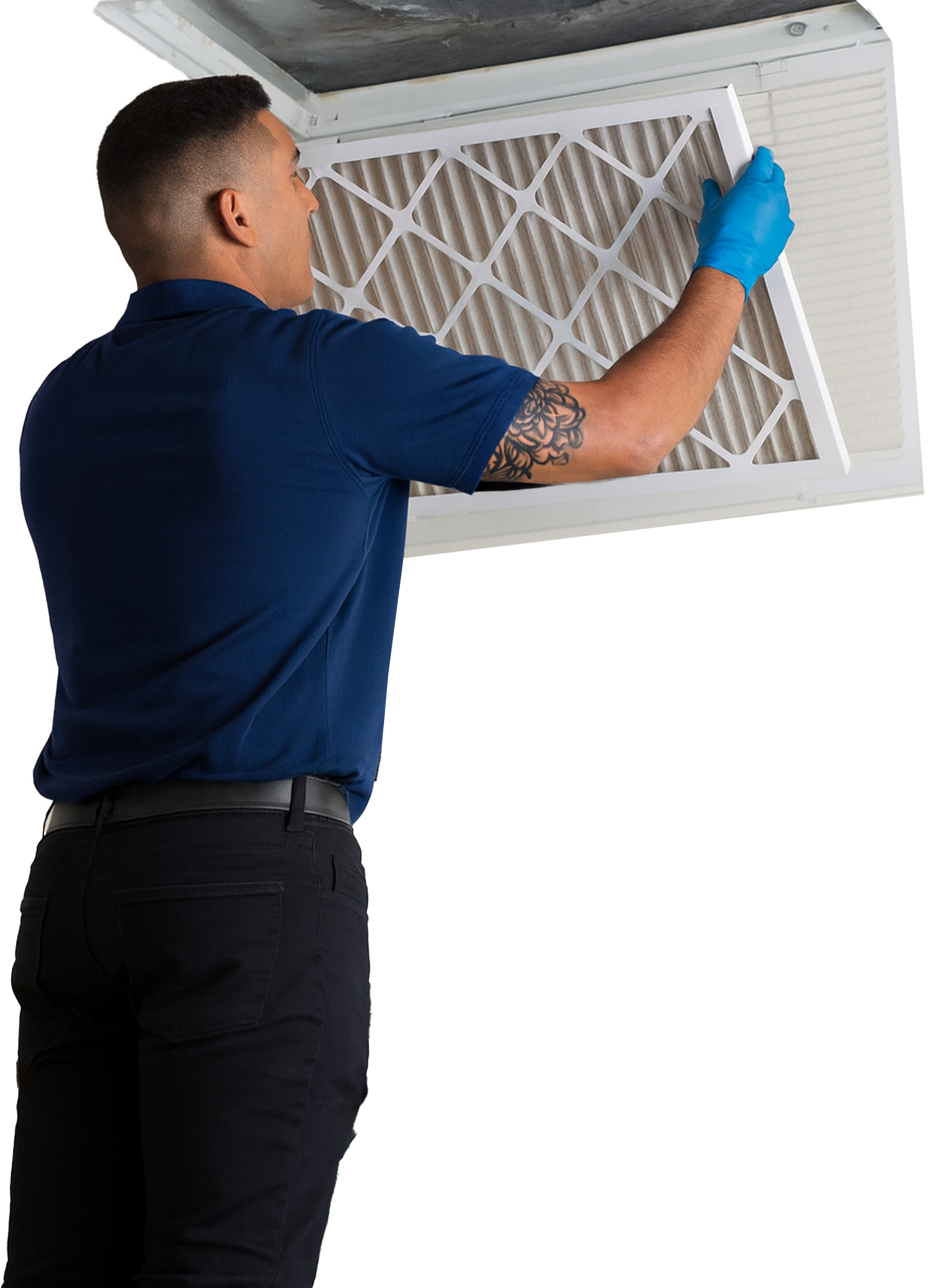
Our contractors ensure your HVAC system does what it’s designed to do
Managing a school, public building, or commercial facility means making sure your HVAC systems circulate, protect health, improve energy efficiency, and meet California's strict Indoor Air Quality (IAQ) standards.
Understanding exactly what's required, and what action to take can be confusing.
Skilled + Trained contractors help you assess your building, improve ventilation, and ensure your project aligns with state requirements —protecting your people, and your budget.
How Indoor Air Quality Improves Learning, Productivity, and Attendance
Indoor air quality is about more than comfort, it has a measurable impact on how people learn, work, and perform. Research has consistently shown that buildings providing adequate ventilation, proper temperature control, and effective air filtration support healthier occupants while improving educational outcomes, workplace productivity, and reducing absenteeism
-
Students perform better in classrooms with healthy indoor air. A study of 70 elementary schools in the southwestern United States found that schools maintaining proper indoor temperatures and higher ventilation rates had 13–14% more students achieving satisfactory scores in mathematics and reading compared to schools with higher temperatures and lower ventilation rates (1). Similarly, research published in the International Journal of Ventilation found that poor classroom ventilation reduced students' power of attention by approximately 5% (2), an impact comparable to a child attending school without eating breakfast. These findings demonstrate that providing adequate outdoor air and maintaining comfortable indoor conditions directly supports student learning and academic achievement.
U. Haverinen-Shaughnessy, R.J. Shaughnessy, E.C. Cole, O. Toyinbo, D. J. Moschandreas, An assessment of indoor environmental quality in schools and its association with health and performance, Build. Environ. 93 (2015) 35–40. https://www.semanticscholar.org/paper/An-assessment-of-indoor-environmental-quality-in-Haverinen-Shaughnessy-Shaughnessy/d8ce5901edcd7401e118bf43d4bce436a77cb82e
David A. Coley, RupertGreeves, and Brian K. Saxby, “The effect of Low Ventilation Rates on the cognitive function of a Primary School Class,” International Journal of Ventilation 6, no. 2 (2007):107-112
-
The quality of a building's indoor environment also affects employee performance. Studies estimate that improving indoor air quality can increase workplace productivity by 2% to 10% (1), resulting in meaningful gains for employers and organizations. Researchers at Lawrence Berkeley National Laboratory further found that employee performance declined by up to 8.9% (2) when indoor temperatures were outside the optimal comfort range. Properly operating HVAC systems help maintain both ventilation and thermal comfort, creating healthier, more productive workplaces.
P. Wargocki et al., “The Effects of Outdoor Air Supply Rate in an Office on Perceived Quality, Sick Building Syndrome (SBS) Symptoms and Productivity,” Indoor Air 10, no. 4 (2000):222-236; B. W. Olesen, “Indoor Environment Health-Comfort and Productivity,” 2005, http//perfectproblems.com/testashrae/Olsen-Health-comfort-productivity.pdf; W.J. Fisk, ”Health and Productivity Gains from Better Indoor Environments and Their Relationship with Building Energy Efficiency,” Annual Review of Energy and the Environment 25 (2000):537-566
O. Seppanen, W.J. Fisk, and Q.H. Lei, “Effect of Temperature on Task Performance in Office Environment” (paper, Ernst Orando Lawrence Berkeley Naional Laboratory, Berkeley, July 2026), http://eta-publications.lbl.gov/sites/default/files/lbnl-60946.pdf
-
Healthy buildings don't just improve performance, they also help keep people at school and work. A two-year study of 162 classrooms found that student absenteeism decreased by 1.6% for every 2 cubic feet per minute (CFM) of outdoor air provided per person (1). Similar benefits have been documented in office environments, where healthier buildings have been associated with 1.6 fewer sick days per employee each year (2). Another study of more than 3,000 occupants across 40 office buildings concluded that 35% of short-term sick leave could be attributed to inadequate ventilation (3).
Investing in proper ventilation, filtration, and ongoing HVAC system verification is an investment in people. Whether in a school, office, healthcare facility, or commercial building, healthy indoor air supports better learning, higher productivity, improved well-being, and fewer absences, benefits that extend well beyond energy savings.
Mendell MJ, Eliseeva EA, Davies MM, Spears M, Lobscheid A, Fisk WJ and Apte MG. Association of classroom ventilation with reduced illness absence: a prospective study in California elementary schools. Indoor Air 2013; 23: 515-528D.K.
Milton et L., “A Study of Indoor Carbon Dioxide Levels and Sick Leave among Office Workers,” Environmental Health 1 (2002): article 3
Milton DK, Glencross PM, Walters MD. Risk of sick leave associated with outdoor air supply rate, humidification, and occupant complaints. Indoor Air. 2000 Dec;10(4):212-21. doi: 10.1034/j.1600-0668.2000.010004212.x. PMID: 11089326.
The right IAQ & ventilation solutions
-
The California Mechanical Code (CMC) (See Chapter 4 - Ventilation Air) establishes minimum ventilation and filtration requirements to help protect occupant health and maintain acceptable indoor air quality. However, as buildings evolve over time, the way individual spaces are used often changes without corresponding updates to the HVAC system.
For example, a room originally designed for storage may now serve as an office with several occupants, or a classroom designed for 30 students may routinely accommodate 40. While your existing HVAC system may have the capacity to serve these new conditions, it can only do so if the ventilation rates, airflow, controls, and system settings have been properly evaluated and adjusted.
A Skilled + Trained HVAC professional can assess your building's current use, verify that the ventilation system meets applicable code requirements, and recommend any adjustments needed to help ensure your building continues to provide a healthy, comfortable, and code-compliant indoor environment.
-
Many buildings are capable of providing healthy indoor air but fail to do so because of operational, maintenance, or control issues. Fortunately, many of these problems can be identified and corrected through proper testing, adjustment, and maintenance.
1. HVAC Systems Are Not Operated During Occupied Hours
Unlike a residential HVAC system that cycles on and off only when heating or cooling is needed, commercial HVAC systems are designed to provide ventilation whenever a building is occupied. Their job is not only to maintain a comfortable temperature but also to continuously deliver fresh outdoor air, filter recirculated air, and dilute indoor contaminants.
When HVAC systems are shut off during occupied hours, occupants may still feel thermally comfortable, but the building is no longer receiving the outdoor air required to maintain healthy indoor air quality.
2. HVAC Systems Are Turned Off Because of Noise or Occupant Complaints
Many occupants are unaware that a commercial HVAC system does much more than provide heating and cooling. Once a room reaches a comfortable temperature, building operators or occupants may shut the system off because it is perceived as noisy. While this may eliminate the sound, it also stops the delivery of outdoor air and filtration, reducing indoor air quality.
Excessive noise is often an indication that the system has not been properly installed, adjusted, or maintained. A qualified Testing, Adjusting, and Balancing (TAB) technician can identify the cause and restore the system to quiet, efficient operation. A properly operating HVAC system should maintain a healthy indoor environment with minimal disruption to occupants.
3. Ventilation Systems Are Poorly Maintained
Ventilation systems require periodic inspection, maintenance, and adjustment to continue performing as designed. Unfortunately, maintenance is often performed by individuals who have not received specialized HVAC training or completed a state-approved apprenticeship program. Over time, dirty filters, failed controls, damaged dampers, worn components, and incorrect control settings can significantly reduce ventilation performance.
Many buildings already have HVAC systems capable of meeting ventilation requirements—they simply are no longer operating as intended.
4. Outdoor Air Is Reduced to Save Energy
Because conditioning outdoor air requires energy, some building operators intentionally reduce ventilation by closing or restricting the outdoor air intake dampers. Others may temporarily reduce outdoor air during extremely hot or cold weather to lower utility costs.
While these adjustments may seem harmless, they often remain in place long after the weather changes or maintenance is completed. As a result, buildings can operate for months, or even years, with inadequate ventilation, exposing occupants to poor indoor air quality while remaining completely unnoticed.
Regular testing and verification by a Skilled + Trained HVAC professional helps ensure that your ventilation system continues to provide the outdoor air, filtration, and comfort your building was designed to deliver while maintaining energy-efficient operation.
-
A ventilation system may appear to be operating correctly while still failing to deliver the outdoor air, airflow, and control sequences needed to maintain healthy indoor air quality and energy efficiency. Physical ventilation verification goes beyond reviewing plans or building automation system (BAS) data by measuring actual system performance in the field.
Using calibrated instruments, a Skilled + Trained HVAC professional verifies that ventilation rates, airflow, filtration, controls, and outdoor air delivery meet the building's design intent and applicable code requirements. This process identifies issues that cannot be detected through visual inspection alone, ensuring the HVAC system is delivering healthy indoor air while operating as efficiently as possible.
Physical verification also provides measurable financial benefits. Research has shown that:
Verifying energy-saving control sequences in new construction and retrofit projects delivers significant, cost-effective energy savings.
Commissioning existing buildings can reduce energy consumption by up to 16% by identifying and correcting operational deficiencies (1).
Studies implementing optimized HVAC control sequences across six commercial building types achieved 12% to 60% HVAC energy savings after field verification and adjustment (2).
While organizations such as ASHRAE have developed optimized ventilation and control strategies, those energy savings are only realized when systems are physically tested, adjusted, and verified to perform as intended.
The result is a healthier building that provides the required ventilation for occupants while maximizing comfort, reducing operating costs, and ensuring the HVAC system performs as designed.
You can't improve what you don't measure. Physical ventilation verification transforms design intent into real-world building performance.
Evan Mills, Building Commissioning: A Global Opportunity for Reducing Energy Costs and Greenhouse Gas Emissions (Berkeley: A Lawrence Berkely National Laboratory, July 21, 2009) http//cx.lbl.gov/documents/2009-assessment/lbnl-cx-cost-benefit.pdf
Standardized HVAC sequence of Operations Savings Calculator. ETCC. (n.d.). Retrieved April 26, 2023, from https://www.etcc-ca.com/reports/standardized-hvac-sequence-operations-savings-calculator

Pro Tip: Most buildings do not provide adequate ventilation. Not verifying outside air rates with physical measurements can increase energy costs and reduce indoor air quality.
Healthy Indoor Air Supports Healthier People
The air inside your building has a direct impact on the health and well-being of the people who occupy it. Proper ventilation and effective air filtration help dilute and remove airborne contaminants, allergens, and fine particulate matter while reducing exposure to pollutants that can contribute to respiratory illness. Whether in schools, offices, healthcare facilities, or commercial buildings, a properly operating HVAC system plays a critical role in creating healthier indoor environments.
-
Asthma is the most common chronic childhood disease in the United States, affecting more than six million children (1), with nearly one in every thirteen school-aged children living with the condition (2). Asthma is also a leading cause of school absenteeism, resulting in approximately 13.8 million missed school days each year (3).
Poor indoor air quality can trigger or worsen asthma symptoms (4,5) by exposing occupants to airborne allergens, dust, smoke, mold spores, and fine particulate matter. Research suggests that improving filtration by replacing lower-efficiency filters with higher-efficiency filters, such as MERV 13, can reduce asthma-related health burdens (6) by removing a significantly greater percentage of these harmful airborne particles. Maintaining adequate ventilation and properly functioning HVAC systems helps create healthier environments for everyone, especially those with respiratory conditions.
''The Links Between Air Pollution and Childhood Asthma," US Environmental Protection Agency, 2018, https://www.epa.gov/sciencematters/links-between-air-pollution-and-childhood-asthma.
Environmental Protection Agency. (2022, December 5). Why Indoor Air Quality is Important to Schools. EPA. Retrieved May 1, 2023, from https://www.epa.gov/iaq-schools/why-indoor-air-quality-important-schools
Zahran et al., "Vital Signs: Asthma in Children - United States, 2001-2016," 2018.
EPA, Environmental Protection Agency, https://www.epa.gov/iaq-schools/managing-asthma-school-environment.
Centers for Disease Control and Prevention. (2022, August 11). Hierarchy of controls. Centers for Disease Control and Prevention. Retrieved September 17, 2022, from https://www.cdc.gov/niosh/topics/hierarchy/default.html
Sheena E. Martenies and Stuart A. Batterman, "Effectiveness of Using Enhanced Filters in Schools and Homes to Reduce Indoor Exposures to PM2.5 from Outdoor Sources and Subsequent Health Benefits for Children with Asthma," Environmental Science & Technology 52, no. 18 (2018): 10767- 76, https:f/doi.org/10.1021/acs.est.abo2053.
-
Children are particularly susceptible to poor indoor air quality because their bodies and lungs are still developing. Students spend approximately 1,000 hours each year in school (1), second only to the amount of time they spend at home. During these critical developmental years, children breathe significantly more air relative to their body weight than adults (2). In fact, the average breathing rate during the first twelve years of life is nearly twice that of an adult on a body-weight basis (3), increasing their exposure to airborne contaminants.
Providing adequate ventilation and effective filtration in schools helps reduce exposure to pollutants while creating healthier learning environments where students can thrive.
Drew DeSilver, "School Days: How the US Compares with Other Countries," Pew Research Center, 2014,https:/fwww.pewresearch.org/fact-tank/2014/09/02/school-days-how-the-u-scompares-with-other-countries/.
Centers for Disease Control and Prevention. (2020, September 1). How are children different from adults? Centers for Disease Control and Prevention. Retrieved April 23, 2023, from https://www.cdc.gov/childrenindisasters/differences.html
Miller, Mark D., et al. "Differences between children and adults: implications for risk assessment at California EPA." International journal of toxicology 21.5 (2002): 403-418
-
One of the greatest indoor air quality challenges is PM2.5, or particulate matter that is 2.5 micrometers or smaller. These microscopic particles are small enough to bypass the body's natural defenses and travel deep into the lungs, where they can contribute to respiratory and cardiovascular health problems. PM2.5 is commonly generated by wildfire smoke, vehicle emissions, combustion processes, cooking, and other indoor and outdoor sources.
Air filtration plays a critical role in reducing occupant exposure to PM2.5. A typical MERV 8 filter captures approximately 50% of PM2.5 particles, while a MERV 13 filter captures up to 90% of these fine particles. When compatible with the HVAC system, upgrading to MERV 13 filtration can dramatically improve indoor air quality and provide greater protection during periods of poor outdoor air quality, including wildfire smoke events.
Healthy buildings begin with healthy air. By combining proper ventilation, effective filtration, and regular performance verification by Skilled + Trained HVAC professionals, building owners can create indoor environments that better protect occupant health, reduce respiratory risks, and improve quality of life for everyone inside.
-
A new HVAC system does not automatically guarantee proper ventilation or indoor air quality. Even newly constructed buildings and recently replaced HVAC systems can fail to deliver the outdoor air, airflow, and filtration they were designed to provide if they are not installed, commissioned, and adjusted correctly.
Research has consistently shown that installation quality remains a significant challenge. A California Energy Commission study found that more than 50% of new HVAC systems and 85% of replacement systems (1) were not performing correctly due to installation deficiencies. Likewise, the U.S. Department of Energy's review of 44 field studies concluded that duct leakage, airflow deficiencies, and refrigerant charge faults are pervasive, with most systems operating below their rated efficiency (2). These deficiencies not only waste energy but can also reduce ventilation rates, diminish occupant comfort, and compromise indoor air quality.
The problem extends beyond residential buildings. A 2019 study by the University of California, Davis and Lawrence Berkeley National Laboratory evaluated classroom HVAC systems that had been replaced within the previous three years. Despite being relatively new, only about 15% of classrooms achieved a median ventilation rate of 15 CFM per person (3), demonstrating that the age of an HVAC system alone is not a reliable indicator of performance.
The good news is that these issues are often correctable. The only way to know whether your building is receiving the required amount of outdoor air and operating as designed is through testing and verification. A Skilled + Trained HVAC professional can evaluate your system, measure its performance, and make the adjustments necessary to ensure it delivers healthy indoor air, occupant comfort, and optimal energy efficiency.
Messenger, M. (2008). Strategic Plan to Reduce the Energy Impact of Air Conditioners. California Energy Commission Staff Report. CEC-400-2008-010. p. 20. & California Energy Commission, Strategic Plan to Reduce the Energy Impact of Air Conditioners (June 2008), CEC-400-2008-010 at p. 5
Residential HVAC Installation Practices: A Review of Research Findings. (n.d.). . US Department of Energy.https://www.energy.gov/eere/buildings/articles/residential-hvac-installation-practices-review-research-findings
Chan, et al, Ventilation rates in California classrooms: Why many recent HVAC retrofits are not delivering sufficient ventilation, Building and Environment Journal 167 (2020) (https://www.sciencedirect.com/science/article/pii/S0360132319306365).
-
Building owners and occupants may assume that commercial buildings routinely provide the minimum amount of outdoor air required for healthy indoor environments. However, field research suggests that proper ventilation cannot be assumed.
A study presented at the 2022 ASHRAE Winter Conference (1) evaluated 95 commercial office buildings to determine whether they met the minimum ventilation rates established by ANSI/ASHRAE Standard 62.1. The researchers found that:
Only 44% of the buildings were providing the minimum required ventilation.
33% were underventilated, but their systems could likely achieve the minimum ventilation rate through proper testing and adjustment by a skilled, trained, and certified technician.
23% were underventilated and required mechanical repairs or system improvements to meet the minimum ventilation rate.
These findings demonstrate that many buildings may not be delivering adequate outdoor air, even when their HVAC systems appear to be operating normally. They also show that more than half of the underventilated buildings could potentially be corrected through professional evaluation, testing, and system adjustment without requiring major equipment replacement.
A Skilled + Trained HVAC professional can measure the outdoor airflow being delivered, compare it with the building’s current occupancy and applicable ventilation requirements, and determine whether adjustments, repairs, or mechanical improvements are needed.
Ventilation performance should be measured and verified—not assumed.
McNulty, M. K., Kono, J., & Abramson, B. (2022 ASHRAE Winter Conference). From Guidance to Implementation: Applying ASHRAE Epidemic Task Force Building Readiness Strategies in 95 Commercial Office Buildings. https://www.thefreelibrary.com/_/print/PrintArticle.aspx?id=713048616
-
Your HVAC system's air filter is one of the most effective tools for improving indoor air quality. Upgrading to a MERV 13 filter, when compatible with your HVAC system, can significantly improve the removal of airborne particles while maintaining energy-efficient operation.
Research has shown that MERV 13 filters provide one of the greatest reductions in airborne infection risk at the lowest overall cost (1) when compared with higher filtration levels or increased ventilation alone.
Use a MERV 13 filtration or better, where the HVAC system can accommodate it, because it is effective at capturing many of the fine airborne particles associated with respiratory aerosols, wildfire smoke, pollen, and other contaminants that affect indoor air quality.(2)
However, simply installing a MERV 13 filter does not guarantee better performance. Higher-efficiency filters create a greater resistance to airflow, and not every HVAC system is designed to accommodate them. If the system is not properly evaluated, a filter upgrade can reduce airflow, decrease ventilation, increase energy consumption, or even damage HVAC equipment.
A Skilled + Trained HVAC professional can determine whether your system is compatible with MERV 13 filtration, verify that adequate airflow and ventilation are maintained, and recommend any adjustments needed to achieve both healthier indoor air and optimal system performance.
The best filtration strategy is one that balances filtration efficiency, ventilation, airflow, and energy performance, not simply installing the highest-rated filter available.
Technicians preforming IAQ or Ventilation work should be certified as an Indoor Air Quality-Ventilation Verification or Testing, Adjusting, and Balancing Technician from an industry recognized certification agency.
Azimi P, Stephens B, 2013. HVAC filtration for controlling infectious airborne disease transmission in indoor environments: Predicting risk reductions and operational costs. Build Environ. 2013(70):150-160. doi:10.1016/j.buildenv.2013.08.025 https://www.ncbi.nlm.nih.gov/pmc/articles/PMC7127325/
"Filtration/Disinfection," ASHRAE, 2021, https://www.ashrae.org/technical-resources/filtration-disinfection#mechanical; and "Planning Framework for Protecting Commercial Building Occupants from Smoke During Wildfire Events," ASHRAE, 2021, https:f/www.ashrae.org/file%20library/technical%20resources/covid-19/guidance-for-commercial-buildingoccupants-from-smoke-during- wildfire-events.pdf..
-
In many cases, yes. Advances in filter technology have made today's MERV 13 filters much more compatible with existing HVAC systems than many people realize.
Modern filters are available with increased surface area, allowing them to capture more airborne particles while maintaining a lower pressure drop across the filter. In many applications, these newer filter designs can provide higher filtration efficiency with little or no increase in airflow resistance.
Research evaluating manufacturer specifications found that almost all buildings had MERV 13 filter options with similar, or even lower, initial pressure drops than the filters they were already using. In a field study of 95 commercial office buildings, only one building was mechanically unable to upgrade to MERV 13 filtration (1).
However, every HVAC system is different. Before upgrading filters, a Skilled + Trained HVAC professional should evaluate the system to determine the highest filtration efficiency it can support while maintaining the required airflow and ventilation rates. This evaluation includes verifying fan capacity, measuring airflow, checking pressure drop, and confirming that the system continues to meet the building's ventilation requirements.
Once the system's filtration capability has been verified, additional indoor air quality improvements—such as increased outdoor air ventilation, air cleaning technologies, or control adjustments, can be considered as part of a comprehensive indoor air quality strategy.
The best filtration upgrade isn't based on assumptions, it's based on measured system performance.
McNulty, M. K., Kono, J., & Abramson, B. (2022 ASHRAE Winter Conference). From Guidance to Implementation: Applying ASHRAE Epidemic Task Force Building Readiness Strategies in 95 Commercial Office Buildings. https://www.thefreelibrary.com/_/print/PrintArticle.aspx?id=713048616
-
The nationally recognized standard for maintaining commercial building ventilation systems is ANSI/ASHRAE Standard 62.1 – Ventilation and Acceptable Indoor Air Quality. The 2025 edition includes a new Chapter 8 – Operations and Maintenance, which provides building owners and facility managers with a practical roadmap for keeping ventilation systems operating as intended.
Rather than focusing solely on system maintenance, Chapter 8 establishes a minimum inspection, verification, and validation program designed to ensure ventilation systems continue delivering the outdoor air, filtration, and indoor air quality they were designed to provide. The standard recognizes that maintaining healthy buildings requires two different levels of evaluation.
Verification
Verification tasks are routine inspections that can generally be performed by building operators or maintenance personnel. These activities include visual inspections, reviewing documentation, checking gauges, monitoring building automation system (BAS) data, and confirming that equipment appears to be operating correctly. These tasks do not require specialized tools, calibrated instruments, or advanced certifications.
Validation
Validation goes a step further. These activities require specialized knowledge, calibrated instruments, testing equipment, and system adjustments to confirm that the HVAC system is actually performing as intended. Examples include measuring outdoor airflow, balancing air distribution, calibrating sensors, verifying pressure relationships, and adjusting ventilation controls. ASHRAE specifies that these tasks should be performed by individuals with specialized training, knowledge, certifications, or licenses.
Why This Matters
Many ventilation problems cannot be identified through a visual inspection alone. A damper may appear to be open but deliver insufficient outdoor air. An airflow sensor may display a value but be out of calibration. A building may feel comfortable while still failing to meet minimum ventilation requirements.
That is why ASHRAE distinguishes between verification and validation. Routine inspections help identify obvious issues, while periodic testing by a Skilled + Trained HVAC professional confirms that the ventilation system is actually delivering the required airflow, filtration, and indoor air quality.
Healthy buildings are not maintained by assumptions… they are maintained through routine verification and professional validation.
A free “Read Only” version of ASHRAE 62.1 2025 can be found here.
-
Portable air cleaners can be an effective way to improve indoor air quality in certain situations, but they are not a replacement for a properly operating building ventilation system. Unlike your building's central HVAC system, portable air cleaners do not provide fresh outdoor air, control building pressure, remove excess humidity, or maintain thermal comfort. Their primary purpose is to clean the air within a limited area.
ASHRAE recommends that in-room air cleaners be used as a supplemental strategy when the existing HVAC system cannot fully achieve the desired ventilation or air-cleaning objectives. The first priority should always be to verify that the building's permanent HVAC system is operating as designed and delivering the required outdoor air, filtration, and airflow to occupied spaces.
Portable air cleaners may incorporate one or more air-cleaning technologies, including:
High-Efficiency Particulate Air (HEPA) Filters – Capture at least 99.97% of airborne particles that are 0.3 microns in diameter, including many fine particles, allergens, and respiratory aerosols.
Ultraviolet Germicidal Irradiation (UVGI) – Uses ultraviolet light to inactivate certain bacteria, viruses, and other microorganisms when properly designed and applied.
Emerging Air-Cleaning Technologies – Technologies such as bipolar ionization, photocatalytic oxidation, and other electronic air-cleaning devices are available. Because performance and effectiveness vary, these technologies should be carefully evaluated using independent scientific research and recognized industry guidance before installation.
For most commercial buildings, the most effective indoor air quality strategy is a properly maintained central HVAC system that provides adequate outdoor air, effective filtration, and balanced airflow throughout the building. Portable air cleaners can then be used to supplement the central system in areas with elevated risk, higher occupancy, or where additional air cleaning is desired.
Think of portable air cleaners as an enhancement, not a replacement, for a healthy building ventilation system.
Learn More: ASHRAE Position Document on Filtration and Air Cleaning provides guidance on selecting and applying filtration and air-cleaning technologies to improve indoor air quality.

Frequently Asked Questions


Why Skilled + Trained Contractors Are the Right Choice for Healthy Buildings

Maintaining healthy indoor air quality requires more than installing HVAC equipment, it requires verifying that ventilation, filtration, and airflow continue to perform as designed throughout the life of the building.
Skilled + Trained HVAC contractors employ apprenticeship-trained professionals who have the knowledge, experience, and specialized testing equipment to measure, evaluate, adjust, and optimize complex commercial HVAC systems. Whether serving schools, offices, healthcare facilities, or public buildings, they help ensure your ventilation system delivers the outdoor air, filtration, and comfort your occupants depend on.
Find a Skilled + Trained Indoor Air Quality Professional. We'll connect you with contractors who help ensure your building performs as intended by
Providing the outdoor air your occupants need
Optimizing filtration to improve indoor air quality
Measuring and verifying ventilation system performance
Diagnosing airflow and HVAC control problems
Maintaining compliance with California codes and recognized industry standards
Delivering healthier, more comfortable, and more energy-efficient buildings